The earliest phases of any architectural project are often the most critical. This phase establishes design fundamentals while budget plans reach their conclusion and space layout rules get established.
The stage of a project presents its highest degree of uncertainty. Technical brainstorming requires traditional 2D sketches as a useful tool; however, their limitations prevent them from showing actual layout conditions.
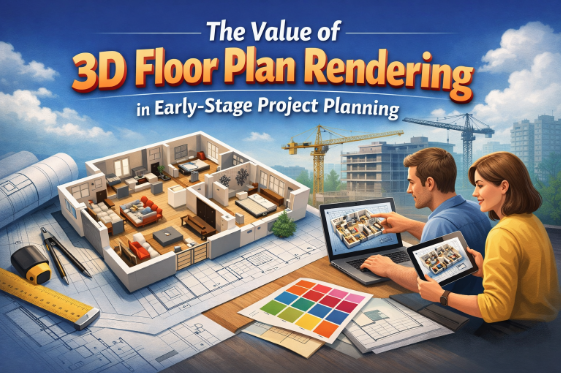
The planning phase requires a 3D floor plan services rendering as an essential tool because it enables better spatial understanding. The ability to visualize project components in three dimensions from the beginning enables developers and designers to make critical decisions with higher precision than flat drawings permit.
Visualizing Scale and Volume Before Commitment
The actual volume of a room remains difficult to determine when using 2D blueprints. The spatial arrangement on paper demonstrates sufficient space until the 3D rendering shows that the ceiling height creates a gigantic space, or the window placement results in a trapped feeling.
The team can evaluate spatial proportions through their early planning work, which uses 3D floor plan services. The early spatial awareness enables instant dimension changes before structural plans and permits applications to establish permanent building measurements.
Testing “What-If” Scenarios at Low Cost
The initial planning stage serves as the most suitable time for design testing. Designers are required to choose between two distinct workspace designs, which include an open-concept office layout and its traditional counterpart with office partitions.
The previous process required extensive resources to produce physical mockups and detailed 2D sets for each design variation. Professional 3D architectural visualization companies can now create multiple 3D scenarios within a short time frame.
Stakeholders use the realistic 3D format to compare different layouts side-by-side while testing their performance under stress conditions. The method of “fail fast” enables only operational and effective design solutions to proceed, which results in sizable time reductions during subsequent project phases.
Identifying Design Flaws Before They Become Budget Issues
The cost of fixing a design error increases exponentially as a project moves toward construction. A wall that is moved on a digital render costs nothing; a wall moved on a construction site can cost thousands.
3D floor plan rendering acts as a powerful diagnostic tool during planning. It shows hidden conflicts through 2D viewing that block identification of a door swing path, which crosses a kitchen island or a column that obstructs primary walking zones.
Businesses can prevent construction phase delays and change order problems by identifying logistical challenges during their first planning meetings.
Improving Stakeholder Buy-In and Alignment
The planning stage demands approval from individuals who do not belong to the groups of architects, investors, city council members, or corporate boards for numerous projects. The stakeholders require a project value demonstration before they will consider providing funds for the initiative.
Technical blueprints create lower confidence levels than polished 3D renders, which show complete design details. 3D architectural visualization company creates project presentations through bird’s-eye views, which remove the concept gap between what stakeholders imagine and what they actually see.
The stakeholders obtain full visibility of their approval process, which enables them to reach decisions faster while making project development through administrative processes more efficient.
Optimizing Functional Flow and Utility
A floor plan functions as a human behavior map, which shows how people will move through different spaces. The planning stage requires building designers to confirm that building flow matches the intended building use.
A residential unit needs to check kitchen views to the backyard, while commercial spaces require lobby design to manage peak foot traffic. 3D rendering allows planners to visualize these movements in context.
Teams from different departments can better arrange doors, stairs, and utilities through functional environment viewing, which helps them achieve optimal building performance from the first day of business.
Conclusion
The project begins with a 3D floor plan rendering to create visual designs that establish clear project boundaries. The process enables intelligent planning through collaborative teamwork that detects errors in advance while conducting complete testing of all ideas and early stakeholder alignment.
Your organization gains strategic advantages through uncertainty resolution when you work with specialized 3D architectural visualization companies during early-stage planning.
The method of proactive planning develops a construction project that achieves both visual appeal and operational efficiency while staying within budget constraints, thus creating a successful project path from initial construction to final inspection.