
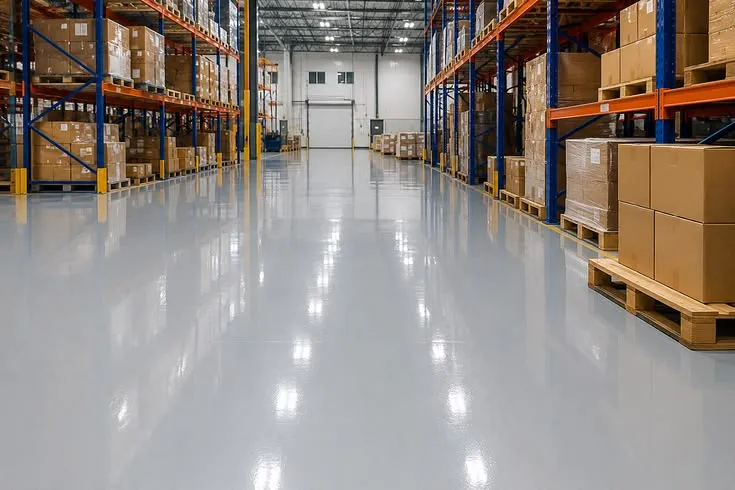
A warehouse floor may look like a simple concrete surface, but it supports almost every part of daily operations. Forklifts, pallet jacks, storage racks, spills, loading activity, and constant foot traffic all place stress on the slab. When wear becomes visible, resurfacing is not only an appearance decision. The chosen system can affect safety, maintenance, productivity, and long-term repair costs. Facility managers therefore need to evaluate concrete condition, operating demands, and installation requirements before approving a new coating system.
Start With the Existing Concrete
The first step is understanding what is happening beneath the worn surface. Cracks, spalling, uneven areas, old coatings, oil contamination, and moisture problems can interfere with a new flooring system. Covering these defects without proper preparation may create a floor that looks improved initially but fails earlier than expected.
A professional assessment should identify whether damaged sections need patching, joints require repair, or moisture mitigation is necessary. Mechanical preparation such as diamond grinding or shot blasting is often used to create the profile needed for strong adhesion. The goal is to build the new system on a stable substrate rather than simply cover visible wear.
Match the System to Traffic
Not every warehouse places the same demands on its floor. A light-storage facility may experience mainly pedestrian and pallet-jack traffic, while a distribution center can have forklifts moving continuously through aisles and turning zones. Loading docks, battery-charging stations, and chemical-handling areas may each require different performance characteristics.
This is why choosing a Warehouse Flooring Contractor should involve more than comparing coating colors or initial prices. The contractor should understand traffic patterns, loads, abrasion, cleaning procedures, and chemicals that may contact the floor. A system designed around real operating conditions is more likely to perform consistently across the facility.
Consider Safety Requirements
Flooring can contribute directly to workplace safety. Smooth surfaces are easier to clean, but environments exposed to water, oils, powders, or processing residues may need additional texture. Slip resistance should be selected according to how the space is used rather than assuming that more texture is always better.
Excessively aggressive texture can make cleaning harder, while an overly smooth finish may be unsuitable for wet zones. Facilities may also use colors or markings to define pedestrian paths, forklift lanes, restricted spaces, or work cells. Planning these details before installation allows the finished floor to support traffic control as well as durability.
Plan Around Downtime
Floor resurfacing affects production schedules. Equipment may need to be moved, aisles closed, storage areas cleared, and sections temporarily removed from service. For an active warehouse, the installation sequence can be almost as important as the coating itself.
Facility managers should discuss curing requirements, phased installation, access restrictions, ventilation, and the time needed before forklifts return to the surface. Fast-curing materials can be useful in some applications, but speed should not replace correct surface preparation. A realistic work plan can reduce disruption while protecting installation quality.
Look Beyond the Lowest Bid
Price matters on large industrial floors, but the lowest proposal may not represent the lowest long-term cost. Differences in preparation, material thickness, repairs, topcoats, labor, and warranty terms can create major differences between quotations that initially appear similar.
When comparing the best epoxy floor contractors, facility managers should examine what is included in the specification. A detailed proposal should explain preparation methods, repair work, coating layers, expected thickness, and assumptions about the slab. Comparing complete systems is more useful than comparing only the final quoted price.
Think About Maintenance Early
The maintenance plan should be considered before a new floor is installed. Warehouses collect tyre marks, dust, packaging debris, oils, and other contaminants. A seamless resinous surface can simplify cleaning, but its performance still depends on appropriate maintenance.
Managers should understand recommended cleaning products, whether abrasive tools should be avoided, and how small areas of damage should be addressed. Early repairs can prevent a local defect from becoming a larger problem. Maintenance teams should also know which chemicals are compatible with the installed system.
Conclusion
A successful warehouse floor project begins with operational planning rather than simply choosing a coating. The existing slab, vehicle traffic, safety needs, chemical exposure, cleaning requirements, downtime, and long-term maintenance all influence which system is appropriate. Careful preparation and a clear installation specification can help reduce premature wear and repeated repairs.
For facility managers, the strongest decision is usually based on total performance over time. By matching the flooring system to actual warehouse demands, businesses can create a surface that supports safer movement, easier maintenance, and more reliable day-to-day operations.